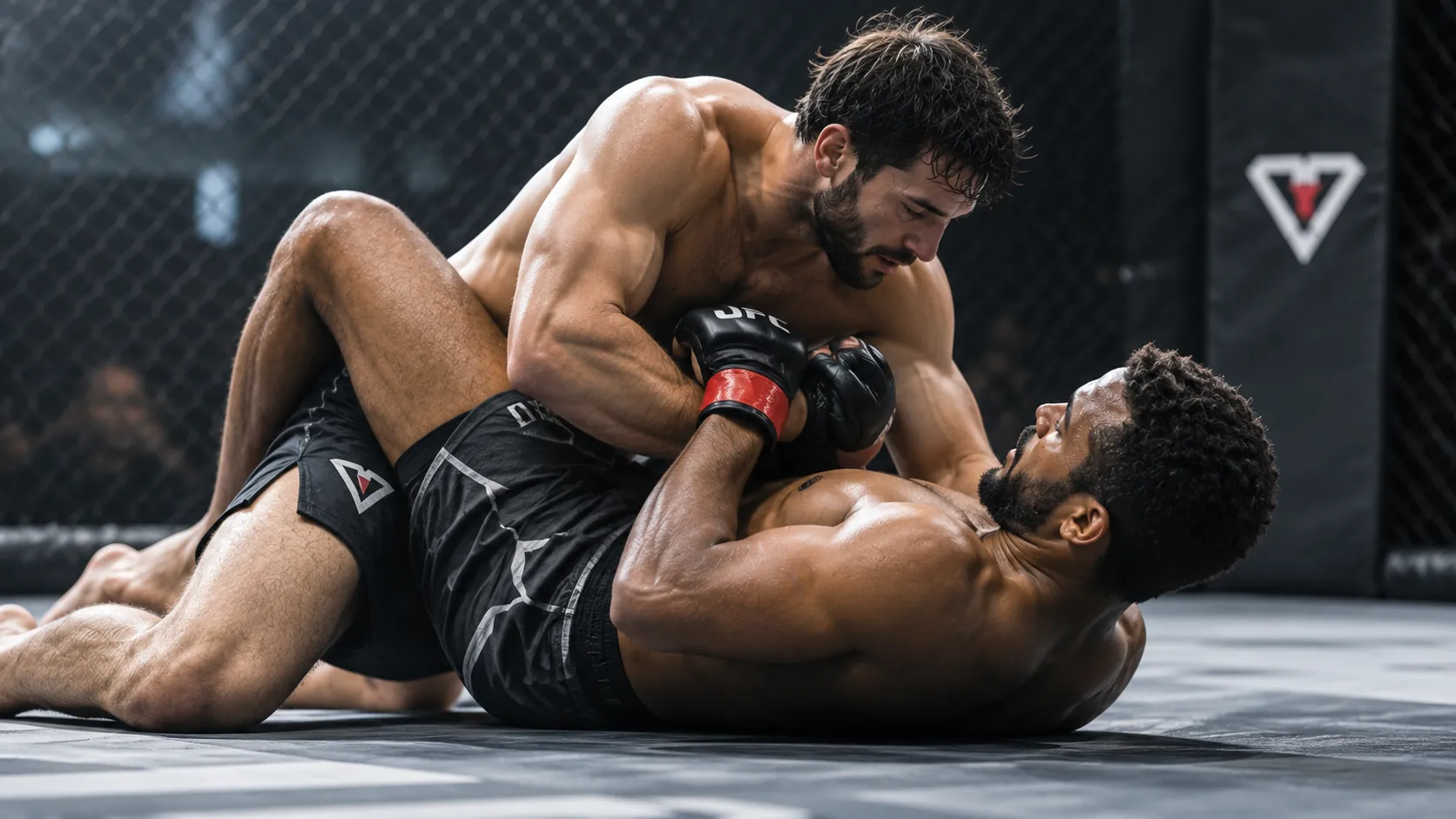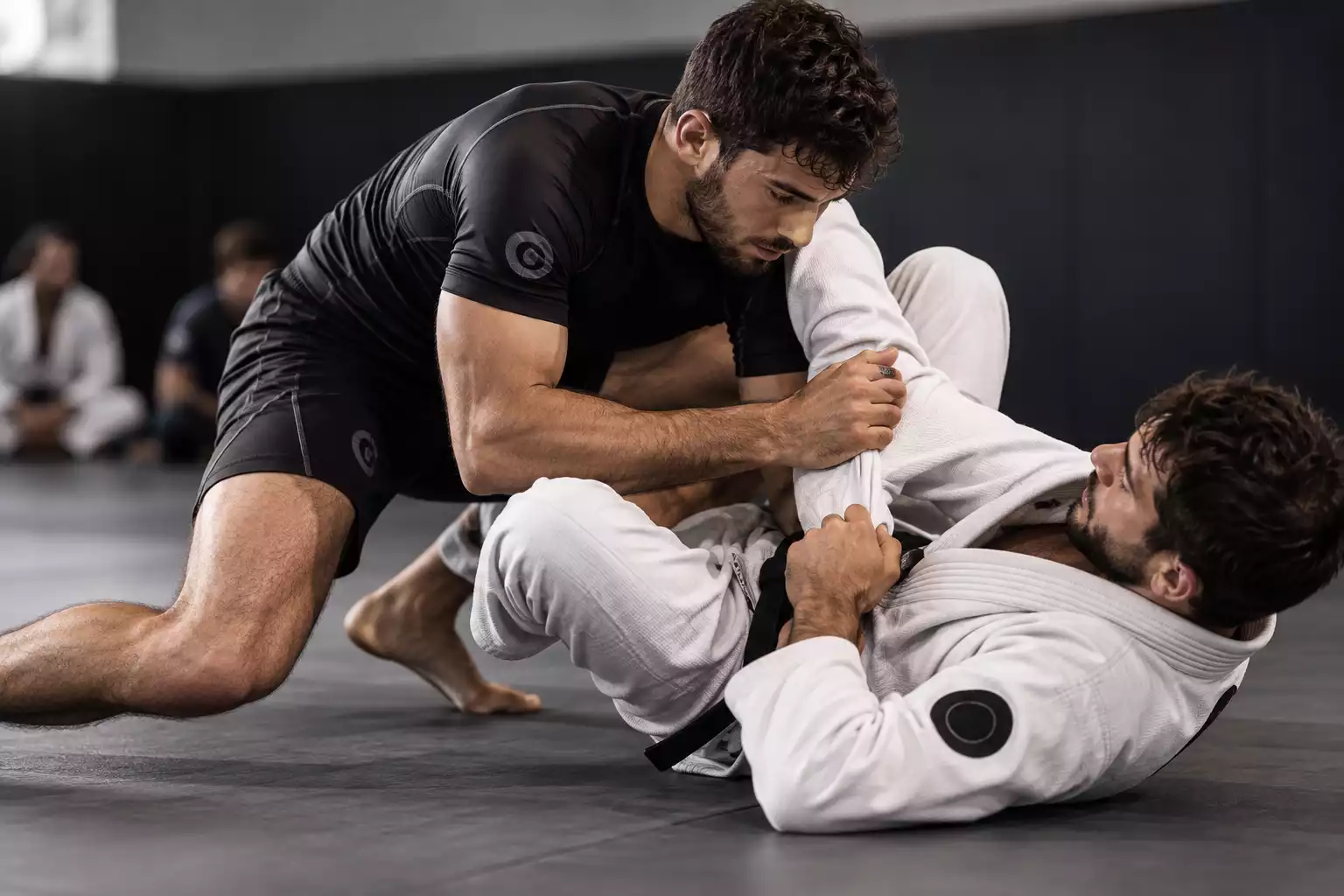
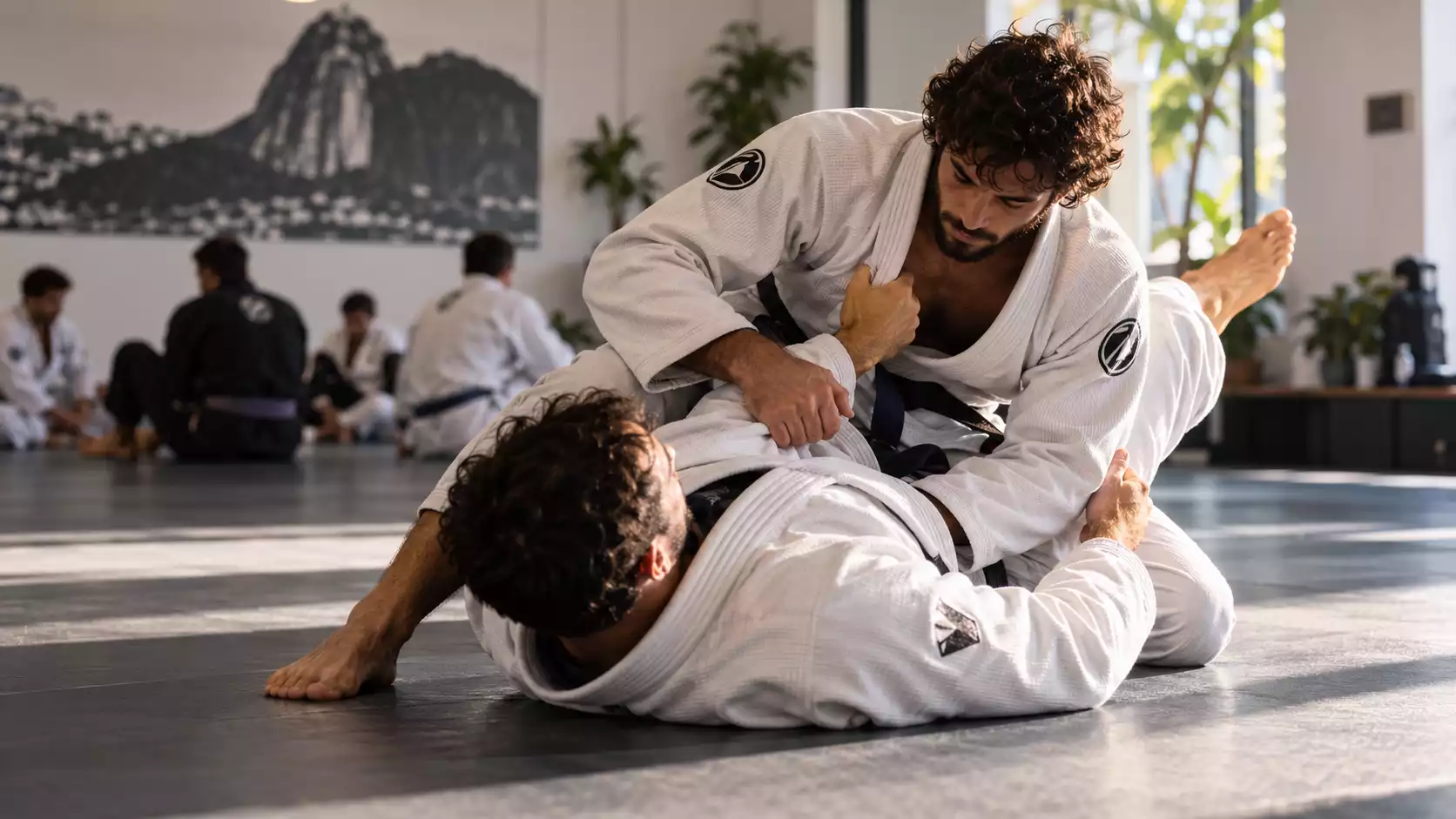
From the first academies in Belém to major international competitions, Brazilian Jiu-Jitsu has developed a distinctive culture of ground fighting. Rooted in Japanese martial arts and shaped by generations of practitioners in Brazil, BJJ combines positional control, leverage, submissions, and strategic thinking.
Brazilian Jiu-Jitsu (BJJ), also commonly written as Brazilian Jiu Jitsu, is a martial art and combat sport centered on grappling, body control, and submission techniques.
Unlike striking-based disciplines, this form of Jiu-Jitsu places particular emphasis on what happens when a fight reaches the ground. Guards, sweeps, positional transitions, joint locks, and chokes form the foundation of its technical repertoire.
On the mats, strength alone is not enough. Timing, balance, leverage, and the ability to anticipate an opponent's movements are essential. An experienced practitioner may gain an advantage over someone physically stronger, although size, athletic ability, and experience still matter.
Today, BJJ brings together a worldwide community of beginners, recreational practitioners, instructors, and elite competitors.
But where did this martial art originate? How does a match work? What techniques should beginners understand, and how can you start training?
1. What Is Brazilian Jiu-Jitsu?
Brazilian Jiu-Jitsu is a close-contact martial art in which two practitioners attempt to gain advantageous positions, control their opponent, or secure a submission.
It belongs to the broader family of grappling disciplines, which involve techniques such as takedowns, throws, pins, joint locks, and chokes.
The Core Principle: Technique Over Strength Alone
BJJ relies on several fundamental principles:
- Leverage: Using mechanical advantage to apply force efficiently.
- Body positioning: Maintaining control while limiting an opponent's movements.
- Weight distribution: Applying pressure effectively without relying entirely on muscular strength.
- Balance and off-balancing: Creating opportunities for sweeps, takedowns, and positional transitions.
- Timing and anticipation: Recognizing movements and responding with appropriate techniques.
These principles explain why technical knowledge plays such a central role in Brazilian Jiu-Jitsu.
However, BJJ does not eliminate physical advantages. Strength, endurance, flexibility, weight, and athletic ability can all influence the outcome of a match, especially between practitioners of similar technical skill.
Why Is Ground Fighting So Important?
In many combat sports, a fight is interrupted or restarted when competitors reach the ground.
Brazilian Jiu-Jitsu takes a different approach.
Ground fighting is a fundamental part of the discipline, and practitioners may spend extended periods working from positions such as guard, side control, mount, or back control.
Students learn how to maintain dominant positions, escape unfavorable situations, and apply submission techniques.
This emphasis on ground fighting is one of the defining features of BJJ.
2. The Origins and History of Brazilian Jiu-Jitsu
The history of Brazilian Jiu-Jitsu is closely connected to Japanese martial arts, particularly jujutsu and the development of modern judo.
Japanese Roots: Jujutsu and Judo
Traditional Japanese jujutsu encompassed various systems of close-combat techniques, including throws, joint locks, and immobilizations.
In 1882, Jigoro Kano founded the Kodokan, establishing the foundations of modern judo.
Kano developed a structured educational and training system that incorporated techniques from earlier Japanese martial arts traditions.
At the time, the terms judo and jujutsu were not always clearly distinguished internationally.
The techniques and training methods that eventually influenced Brazilian Jiu-Jitsu emerged from this historical background.
Reference [1]: Kodokan Judo Institute — History of Kodokan Judo.
Mitsuyo Maeda and the Arrival of Japanese Martial Arts in Brazil
During the early 20th century, several Japanese martial artists contributed to the introduction and development of grappling disciplines in Brazil.
One of the most influential figures was Mitsuyo Maeda, a Kodokan-trained judoka also known as Conde Koma.
After traveling internationally and participating in martial arts demonstrations and contests, Maeda arrived in Brazil in 1914.
He eventually established himself in Belém, where he helped introduce Japanese grappling techniques to local students.
His teaching influenced Carlos Gracie and the martial arts community around him.
However, the precise circumstances of this transmission remain the subject of historical discussion.
Research suggests that Carlos Gracie may have learned through both Maeda's instruction and that of Jacyntho Ferro, an instructor associated with Maeda's school.
The origins of Brazilian Jiu-Jitsu should therefore not be reduced to a single teacher-student relationship.
Reference [2]: José Cairus, Modernization, Nationalism and the Elite: The Genesis of Brazilian Jiu-Jitsu, 1905–1920.
The Gracie Family and the Development of BJJ
Carlos Gracie and several members of his family played important roles in organizing, teaching, and promoting Brazilian Jiu-Jitsu.
Hélio Gracie became another prominent figure through his teaching, technical development, and participation in martial arts contests.
Over time, Brazilian Jiu-Jitsu developed distinctive training methods and placed increasing emphasis on ground fighting and submissions.
The term Gracie Jiu-Jitsu, sometimes written as Gracie Jiujitsu, is associated with the teaching traditions and methods developed within the Gracie family. The name continues to be used by schools that identify with this historical and technical lineage.
However, the development of Brazilian Jiu-Jitsu extends beyond the Gracie family. Other practitioners and teaching lineages, including those associated with Luiz França and Oswaldo Fadda, also contributed to the evolution and wider adoption of the discipline.
Reference [3]: Primórdios do jiu-jitsu e dos confrontos intermodalidades no Brasil: contestando uma memória consolidada.
International Expansion and the Rise of MMA
Brazilian Jiu-Jitsu gained significant international attention during the 1990s.
In 1993, Royce Gracie won the first Ultimate Fighting Championship (UFC) tournament, using grappling and submission techniques against opponents from different martial arts backgrounds.
His performances helped introduce Brazilian Jiu-Jitsu to a much wider audience.
At the same time, specialized BJJ competitions developed, academies expanded internationally, and the sport established its own competitive identity.
Today, Brazilian Jiu-Jitsu is practiced worldwide and remains an important component of mixed martial arts (MMA).
3. How Does a Brazilian Jiu-Jitsu Match Work?
A BJJ match generally involves two competitors facing each other on a designated mat area.
Depending on the competition rules, victory may be achieved through submission, points, or other decision criteria.
The Main Phases of a Match
A match often begins standing, with competitors attempting to establish grips, off-balance their opponent, or execute a takedown.
Once the action moves to the ground, practitioners attempt to establish advantageous positions.
Common objectives include:
- Passing an opponent's guard.
- Establishing dominant positional control.
- Performing a sweep.
- Recovering guard from a disadvantageous position.
- Setting up a submission.
- Escaping a dangerous position.
An important feature of BJJ is that being underneath an opponent does not necessarily mean losing.
Certain guard positions allow practitioners to control, sweep, or submit an opponent while positioned on their back.
What Is a Submission?
A submission is a technique designed to force an opponent to concede defeat.
Common submissions include:
- Joint locks, such as the armbar and kimura.
- Chokes, such as the rear naked choke and triangle choke.
- Leg attacks, which may be restricted depending on the competition rules, age group, and belt level.
When a practitioner wants to submit, they can tap their opponent, tap the mat, or verbally signal their intention to stop.
This action is known as tapping out.
It is an essential safety practice during training and competition.
Knowing when to tap is not a sign of weakness. It is part of learning Brazilian Jiu-Jitsu responsibly.
4. The Main Positions in Brazilian Jiu-Jitsu
Understanding the fundamental positions is essential for learning how BJJ works.
Guard
Guard is a position in which a practitioner uses their legs to control an opponent, usually while sitting or lying on their back.
Common variations include:
- Closed guard.
- Open guard.
- Half guard.
- Butterfly guard.
- De La Riva guard.
- Spider guard.
Each guard provides different opportunities for control, sweeps, submissions, and defensive movements.
Side Control
Side control is a dominant position in which a practitioner controls their opponent from the side.
It allows the top player to restrict movement, apply pressure, and prepare positional transitions or submissions.
Mount
Mount is a dominant position in which one practitioner sits above their opponent's torso, generally with their knees positioned on either side.
It offers strong positional control and several submission opportunities.
Back Control
Back control involves positioning oneself behind an opponent and restricting their movement.
It is particularly valuable because it creates opportunities for chokes while limiting the opponent's ability to defend.
Guard Passing
Guard passing involves overcoming the control established by an opponent's legs to reach a more dominant position.
It is one of the fundamental skills developed in Brazilian Jiu-Jitsu.
5. What Are the Rules of Brazilian Jiu-Jitsu?
BJJ competition rules vary depending on the organization and tournament format.
There is no single universal ruleset used in every Brazilian Jiu-Jitsu competition.
One of the most widely recognized competitive systems is maintained by the International Brazilian Jiu-Jitsu Federation (IBJJF).
How Does the Points System Work?
Under IBJJF rules, certain techniques and positions can earn points when the required conditions are met.
| Technique or position | Points |
|---|---|
| Takedown | 2 |
| Sweep | 2 |
| Knee on belly | 2 |
| Guard pass | 3 |
| Mount | 4 |
| Back control | 4 |
Points are not awarded automatically whenever a position appears.
Competitors must meet the relevant technical and stabilization requirements.
A successful submission can end a match regardless of the current score.
Other organizations may use different scoring systems, including submission-only formats.
Reference [4]: IBJJF — Rule Book, Version 6.0.
Illegal Techniques and Safety Rules
Not every technique is permitted for every competitor.
Restrictions may depend on:
- Age.
- Belt level.
- Competition category.
- Specific tournament rules.
Certain joint locks, leg attacks, and potentially dangerous movements are prohibited in particular divisions.
Competitors should always consult the official rules of their event before participating.
Reference [4]: IBJJF — Rule Book and Technical Fouls & Illegal Moves.
6. The Brazilian Jiu-Jitsu Belt System
The BJJ belt system represents a practitioner's technical development and experience.
For adult practitioners, the traditional progression includes five main belt colors before the higher ranks.
White Belt
The white belt marks the beginning of the journey.
Students learn fundamental positions, basic movements, safety principles, and introductory defensive techniques.
Blue Belt
The blue belt generally represents a more established understanding of Brazilian Jiu-Jitsu fundamentals.
Practitioners begin developing greater awareness of transitions, positional strategy, and technical combinations.
Purple Belt
The purple belt represents an advanced stage of technical development.
Practitioners typically begin refining their individual style and gaining a deeper understanding of different positions and strategies.
Brown Belt
The brown belt is an advanced stage of progression toward black belt.
Practitioners continue refining their techniques, transitions, and ability to adapt to different opponents.
Black Belt
The black belt recognizes a high level of technical skill and experience.
However, reaching black belt does not mean the learning process is complete.
For many practitioners, it represents the beginning of another stage of technical exploration and development.
The system also includes higher ranks, while children follow a separate belt progression.
How Long Does It Take to Earn a BJJ Black Belt?
Earning a black belt generally requires many years of consistent training.
The timeline varies according to individual development, training frequency, academy standards, and promotion criteria.
The IBJJF publishes graduation requirements, including minimum time requirements for certain promotions.
These requirements do not guarantee automatic promotion.
Reference [5]: IBJJF — Graduation System.
7. Brazilian Jiu-Jitsu vs. Judo, Grappling and MMA
These disciplines share technical foundations but differ in their sporting rules and strategic priorities.
Brazilian Jiu-Jitsu vs. Judo
Judo and BJJ share important historical roots.
Competitive judo places considerable emphasis on throws and achieving an ippon, although groundwork is also part of the discipline.
Brazilian Jiu-Jitsu generally allows more extensive ground fighting, with greater emphasis on guards, positional transitions, and submissions.
The two disciplines share many techniques and can complement each other.
Brazilian Jiu-Jitsu vs. Grappling
Grappling is a broad term covering combat disciplines based on gripping, controlling, and submitting an opponent.
In everyday martial arts terminology, grappling may also refer to submission-based competition without the traditional Gi.
Brazilian Jiu-Jitsu belongs to the grappling family, but not every grappling competition follows BJJ rules.
Brazilian Jiu-Jitsu vs. MMA
Mixed Martial Arts combines techniques from different combat sports, including boxing, wrestling, kickboxing, and grappling.
BJJ is particularly relevant to ground control, submission attacks, and submission defense.
However, MMA also permits striking, which significantly changes positional strategies and defensive priorities.
Is Brazilian Jiu-Jitsu Still Essential in MMA?
8. Gi vs. No-Gi Brazilian Jiu-Jitsu
Brazilian Jiu-Jitsu can be practiced with a traditional Gi or without it, in No-Gi training. Both formats share the same core grappling principles, but clothing and grip availability significantly influence positional control, movement, and strategy.
Gi BJJ allows practitioners to use the jacket, collar, sleeves, and pants to establish grips, control distance, and set up submissions.
No-Gi BJJ, often associated with submission grappling, removes these traditional fabric grips and places greater emphasis on body positioning, underhooks, overhooks, and other forms of control.
Should Beginners Start With Gi or No-Gi?
Both formats provide opportunities to learn fundamental grappling skills.
The choice depends on personal preferences, academy schedules, and individual goals.
Many practitioners train in both formats to develop complementary skills.
The Advantages of No-Gi Compared to Gi.
9. What Are the Benefits of Brazilian Jiu-Jitsu?
Beyond its technical and competitive aspects, Brazilian Jiu-Jitsu may offer physical, psychological, and social benefits.
However, individual experiences vary, and these outcomes should not be considered automatic.
Improving Physical Fitness
BJJ training can challenge several physical abilities:
- Cardiovascular endurance.
- Coordination.
- Mobility.
- Balance.
- Strength.
- The ability to manage repeated periods of physical effort.
Training intensity varies depending on the session, exercises, and partners involved.
As with any contact sport, appropriate progression and responsible training are important for managing injury risks.
Building Self-Confidence
Brazilian Jiu-Jitsu regularly places practitioners in unfamiliar or uncomfortable situations.
Learning to defend positions, remain composed under pressure, and recognize technical improvements may help individuals develop confidence in their abilities.
This confidence generally develops through experience rather than immediate results.
Developing Patience and Discipline
Progress in BJJ takes time.
Some techniques require extensive repetition before they can be applied effectively against a resisting partner.
Consistency, attention, and perseverance therefore become important parts of the learning process.
Building Social Connections
Brazilian Jiu-Jitsu is an individual combat sport learned through cooperation with others.
Training partners play a central role in technical development.
A supportive academy can become a place where practitioners build friendships, exchange knowledge, and share a common passion.
Related reading: The Benefits of Brazilian Jiu-Jitsu for Self-Confidence and Mental Strength.
10. How to Start Brazilian Jiu-Jitsu
You do not need previous martial arts experience to begin BJJ.
Many academies offer classes specifically designed for beginners.
Finding the Right BJJ Academy
Choosing an appropriate academy is an important first step.
Before joining, consider:
- Whether beginner-friendly classes are available.
- Training schedules and class frequency.
- Instructor experience and teaching approach.
- Safety rules and facility hygiene.
- The overall training atmosphere.
- Opportunities to attend a trial class.
A good learning environment should allow students to develop their skills while respecting their experience level and individual needs.
What Happens During Your First BJJ Class?
A typical class may begin with a warm-up or mobility exercises.
The instructor then demonstrates one or more techniques that students practice with a partner.
Depending on the class format, training may also include positional drills or controlled sparring.
Beginners should communicate their experience level, follow safety instructions, and avoid relying on excessive strength.
What Equipment Do You Need?
Equipment depends on the type of class.
For Gi training, students generally need a BJJ kimono and belt.
For No-Gi training, a rashguard and suitable shorts are commonly used.
Clean training clothes, personal hygiene, and a water bottle are also important.
Some academies provide loaner uniforms for introductory classes.
Can You Start BJJ After 30, 40 or 50?
Yes.
People can begin Brazilian Jiu-Jitsu at different stages of adulthood.
The most important considerations are physical condition, personal goals, appropriate training intensity, and any individual health limitations.
Progress may look different from that of a younger competitive athlete, but that does not prevent someone from enjoying the sport or developing meaningful skills.
How to Find a Brazilian Jiu-Jitsu Club and Prepare for Your First Class.
11. Brazilian Jiu-Jitsu Today: A Global Community
Brazilian Jiu-Jitsu has expanded far beyond Brazil.
Academies now operate in many countries, bringing together practitioners from different backgrounds and experience levels.
Some train for competition, while others focus on fitness, self-defense, technical learning, or simply enjoying the sport.
This international community is one of BJJ's distinctive characteristics.
Practitioners can travel to a new city and potentially find an academy where they can train with people who share their passion.
Open mats, which are training sessions organized according to each academy's rules, also contribute to this culture of exchange and connection.
This community is at the heart of OneJitsu, a platform designed to help connect BJJ practitioners, academies, and events.
12. Frequently Asked Questions About Brazilian Jiu-Jitsu
Is Brazilian Jiu-Jitsu Dangerous?
Like any contact sport, BJJ involves injury risks, particularly during takedowns, joint locks, and sparring.
Qualified instruction, responsible training partners, gradual progression, and respecting submission signals can help reduce these risks, although they cannot eliminate them entirely.
Do You Need to Be Strong to Practice BJJ?
No. Exceptional physical strength is not required to start Brazilian Jiu-Jitsu.
The discipline emphasizes technique, positioning, and efficient movement.
However, physical strength remains one of several factors that can influence performance.
What Is the Difference Between BJJ and Brazilian Jiu-Jitsu?
There is no difference.
BJJ is simply the abbreviation for Brazilian Jiu-Jitsu.
In French-speaking countries, the abbreviation JJB is also commonly used.
Is Brazilian Jiu-Jitsu Effective for Self-Defense?
BJJ teaches skills that can be useful in close-contact situations, including balance, control, escapes, and ground fighting.
However, real-world self-defense also involves awareness, avoidance, de-escalation, environmental factors, and potentially multiple attackers or weapons.
BJJ alone cannot guarantee safety in every situation.
Can You Practice BJJ Without Competing?
Absolutely.
Many practitioners train purely for recreation, fitness, technical development, or the social experience of belonging to an academy.
Competition is an option, not a requirement.
Conclusion: More Than a Combat Sport
Brazilian Jiu-Jitsu combines technique, strategy, physical effort, and continuous learning.
Its Japanese roots, development in Brazil, and international expansion have made it a widely practiced martial art with a distinctive sporting identity.
Whether your goal is to discover a new activity, improve your fitness, build confidence, or compete, BJJ offers many opportunities for personal and technical development.
And although progress is individual, learning always involves others: instructors, training partners, and the wider community.
Explore the world of Brazilian Jiu-Jitsu with OneJitsu.
Discover academies, connect with training partners, and explore the events that bring the global BJJ community together.
Sources and References
[1] Kodokan Judo Institute — History of Kodokan Judo
Historical background on Jigoro Kano, the establishment of the Kodokan in 1882, and the development of modern judo.
[2] José Cairus (2011) — Modernization, Nationalism and the Elite: The Genesis of Brazilian Jiu-Jitsu, 1905–1920
Tempo e Argumento, 3(2), 100–121. Historical research examining the introduction of Japanese martial arts in Brazil, Mitsuyo Maeda, and the early development of Brazilian Jiu-Jitsu.
[3] Primórdios do jiu-jitsu e dos confrontos intermodalidades no Brasil: contestando uma memória consolidada (2018)
Revista Brasileira de Ciências do Esporte, 40(3). Historical analysis challenging simplified accounts of Brazilian Jiu-Jitsu's origins.
https://doi.org/10.1016/j.rbce.2018.03.003
[4] International Brazilian Jiu-Jitsu Federation (IBJJF) — Rule Book
Official competition rules covering scoring, positional requirements, penalties, and prohibited techniques.
[5] International Brazilian Jiu-Jitsu Federation (IBJJF) — Graduation System
Official belt and graduation framework, including adult and youth classifications.